image-title


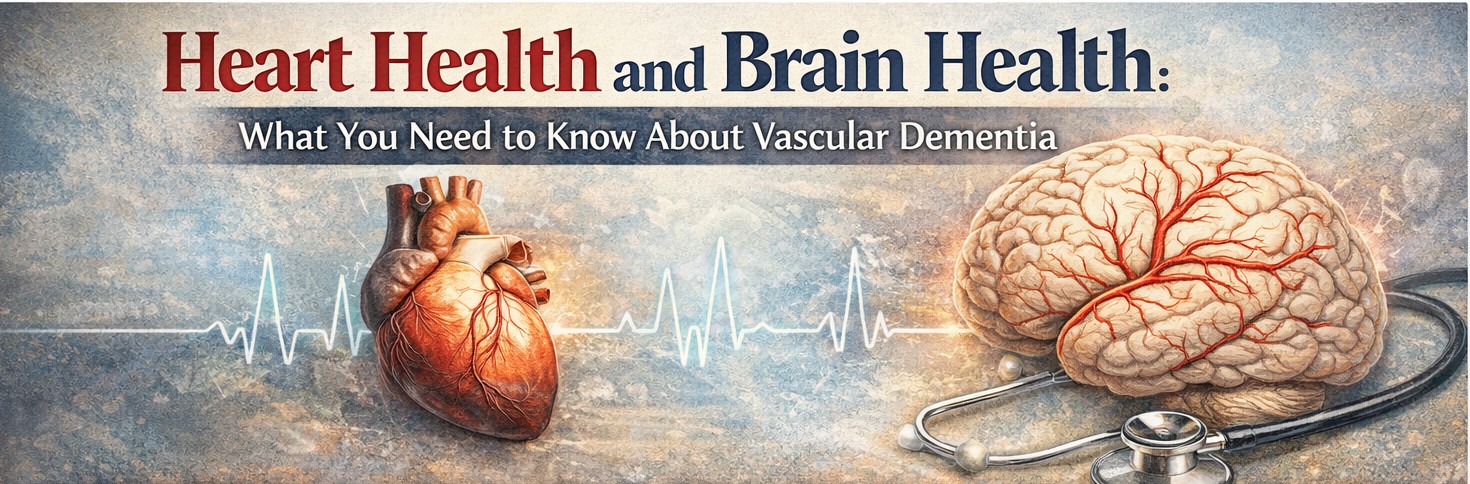
February is American Heart Month, and after many decades of supporting older adults and their families, I have seen firsthand how heart health shapes the quality of life in our later years. The link between your heart and your brain doesn’t get enough attention.

The Second Most Common Form of Dementia

When we think of dementia, most of us immediately think of Alzheimer’s Disease—and for good reason, as it’s the most common form. But there’s another type that deserves far more awareness: vascular dementia. It’s the second most common form of dementia and affects more men than women, yet many people have never heard of it.

Here’s what makes vascular dementia different—and why that difference matters.

It’s Not a Heart Disease, But It Starts with the Heart

Vascular dementia is not heart disease itself. Rather, it’s a type of brain dysfunction directly caused by heart and blood vessel diseases. Think of it this way: when your cardiovascular system is compromised, your brain pays the price.

Vascular dementia develops when cardiovascular issues—like high blood pressure, stroke, or artery disease—damage blood vessels, restricting blood flow and oxygen to the brain. Without adequate blood flow, brain cells are deprived of the nutrients and oxygen they need to function properly. Over time, this leads to cognitive decline.

What Causes Vascular Dementia?

Several heart and vascular conditions can lead to vascular dementia:

  • Heart failure – When the heart cannot pump efficiently
  • Heart attacks – Which can damage the heart’s ability to supply blood
  • Stroke – Both major strokes and “silent” mini-strokes
  • Atherosclerosis – Hardened, narrowed arteries that restrict blood flow
  • High cholesterol – Which contributes to artery blockage

When the heart cannot pump efficiently, or when blood vessels are blocked or damaged, the brain is deprived of vital nutrients. The result is progressive cognitive decline.

Know Your Risk Factors

The common risk factors for vascular dementia are the same ones your doctor has likely already mentioned for heart disease:

  • High blood pressure (hypertension)
  • Diabetes
  • Smoking
  • Sedentary lifestyle
  • High cholesterol
  • Obesity

It’s important to take these seriously, not just for your heart, but for your brain.

The Good News: Prevention Is Possible

Here’s what gives me hope after all these years working with families: because vascular dementia is vascular-based, managing heart health can help prevent or slow its progression.

Unlike some forms of dementia where we’re still searching for answers, the path forward with vascular dementia is clear:

  • Control your blood pressure. This is perhaps the single most important factor. Work with your doctor to keep it in a healthy range.
  • Eat a heart-healthy diet. What’s good for your heart is good for your brain. Focus on fruits, vegetables, whole grains, and lean proteins.
  • Stay active. Regular physical activity improves circulation and keeps both your heart and brain healthy. You don’t need to run marathons—even daily walks make a difference.
  • Manage diabetes. If you have diabetes, keeping your blood sugar controlled protects your blood vessels.
  • Don’t smoke. If you do smoke, quitting is one of the best things you can do for your vascular health.
  • Monitor cholesterol. High cholesterol contributes to the plaque buildup that restricts blood flow.

What I’ve Learned Over the Years

In my decades of working with older adults and their families, I’ve watched how these seemingly small daily choices compound over time. I’ve seen people who took their heart health seriously maintain their cognitive sharpness well into their later years. I’ve also seen families struggle when vascular issues were left unaddressed.

The beauty of this connection between heart and brain health is that it puts power back in our hands. While we can’t control everything about aging, we can control many of the factors that contribute to vascular dementia.

This Heart Month, Think About Your Brain Too

As we observe American Heart Month this February, I encourage you to expand your thinking beyond just your heart. Every step you take to protect your cardiovascular system is also a step toward protecting your cognitive future.

Your future self—and your family—will thank you.


If you or someone you love is living with a diagnosis of vascular dementia and feeling uncertain about what comes next, you don’t have to face it alone.

Contact the experts at Allies in Aging JFS Eldercare Solutions to get compassionate guidance and a thoughtful plan that addresses today’s needs while preparing for the future.


Read More
image-title

Finding Our Way Through the Chaos of Caregiving — With Malka’s Help
By Marv Alpert and Bruce Howell

We recently published a book called Alzheimer’s Caregiving with Love, Laughter, and a Plan, but before we had a “plan,” we had a lot of confusion.

Like so many others, we were thrown headfirst into caregiving without a roadmap. There were so many resources out there—but no clear starting point. The decisions were overwhelming. Medical. Financial. Legal. Emotional. It felt like we were drowning in information and still somehow didn’t know what to do next.

That all changed when we met Malka Young.

Malka didn’t just offer advice—she brought us peace of mind. She sat down with each of us, along with our wives and daughters, and truly listened. Then she helped us sort through the confusion and build a practical, personalized care plan—one that included everything from daily routines to emergency planning (something we didn’t even realize we needed until she pointed it out).

Malka gave us direction, clarity, and comfort. Her support was one of the turning points that made our caregiving journey feel manageable—and, at times, even joyful.

Our book grew out of those experiences. It’s a guide we wish had existed when we were just starting out. It’s honest, practical, and yes, filled with love and laughter. We’re not doctors or lawyers—just two local husbands who lived it and want to help others feel less alone.

We also created a website for caregivers to get instant, confidential answers to their questions: www.caregiversinfo.com. It’s free, easy to use, and based on the book and the best current research. If you try it we’d love feedback on your experience. (write to info@caregiversinfo.com)

If you’re interested, the book is available on Amazon here: https://a.co/d/9Asrp7M

Thank you, Malka, for everything you’ve done for us—and for all the families you continue to guide with such wisdom and compassion.

With gratitude,

Marv Alpert & Bruce Howell

PS Our book was recently featured in The Boston Globe.

Read More
image-title


Dear Ally,

I recently received a call that my 87-year-old mother fell and was being transported to the hospital.  My mother broke her hip.  She refuses to use a mobility aide such as walker or cane.  I’d like her to get a fall alert pendant, but she says she will not use.  HELP- I am frustrated.  What steps can I take to ensure my mother’s safety and prevent future falls?


Sincerely,

Frustrated Son


Dear Frustrated Son,

Thank you for your question.  Many other adult children are concerned about preventing falls for their parents.

As a Geriatric Care Manager, I have an up-coming visit scheduled to do a home safety check.  Come look over my shoulder and see what changes your mom might consider if she wants to increase her safety and minimize the chances of future falls.

The couple I am visiting are determined to stay in their own home and are fearful of ending up in a nursing home. The number one reason older adults end up living the rest of their lives in a nursing home is falls. Knowing this might motivate your mother to make necessary changes.

The first thing I notice is the steep stairs leading to the entrance of the house.  There is only one railing on the left side of the stairway.  To maximize safety, there should be a railing on both sides of a stairway both inside and outside of the house.

When the door opens, I immediately see an area rug right at the entry way. This is the first of three area rugs, one with curling edges and wrinkles across its hand-woven surface.  To maximize safety, remove all area rugs. They are a tripping hazard. I pay attention to the transitions from one room to another, from the wooden floor in the dining room to the tile floor in the kitchen. Floors should be level. Luckily, this is not a problem here.

The house faces north, and though there are multiple lights all over the house, they are all turned low, and the house is dark. Nightlights during the night, and good lighting during the day all contribute to safety.  Nightlights are particularly important in bedrooms and in the bathroom.

Grab bars by the toilet and in the shower make a bathroom safer for older adults. As I check each room, I am looking for clear passageways.  Dog beds and extension cords can be tripping hazards, particularly if they are in the middle of the room.  These are all the environmental factors that contribute to safety and make falls less likely.

Now we sit down and look at the personal factors that can contribute to falls.  As we age our balance naturally changes due to changes in vision, bone mass, restricted mobility, muscle strength and endurance, and increased likelihood of chronic diseases.  These all can increase our likelihood of falling.

A proactive step that your mother can take is to exerciseWe need to work on strength, balance, flexibility as well as endurance. Not unexpectedly, they tell me that they walk every day-their only exercise. They don’t like hearing that walking isn’t enough.  Exercise programs such as Tai Chi, Water Aerobics, Yoga, dance and Pilates are all types of exercise that help us be more confident in our ability not to fall.  I recommended that they consider working with the senior personal trainer on my team to assess their fitness levels, make recommendations for maintaining leg and core strength, and finding exercise programs they can enjoy.  The personal trainer can also come into the home for personalized 1:1 session for balance training.  As I mentioned during the home safety check and consultation:  “If you don’t use it, you lose it.”  More and more research points to the importance of a comprehensive exercise program to prevent falls.

Change is hard. Those older adults who actively make the changes they need to make (such as using mobility aids like canes and walkers) or wearing a PERS (personal emergency response system such as a pendant) or making modifications to the home and EXERCISING are the ones who are more likely to avoid unnecessary falls. No one can “be careful” all the time.  I hope you can share some of this information with your mother, and when she returns home, she will be more receptive.

Regards,

Ally

Written by Malka Young, LICSW, CCM and Laila Vehvilainen, MS, MPH, NASM-CPT, CDP – Your Geriatric Care Managers at Allies in Aging

If you are worried about an aging parent, contact the experts at Allies in Aging to learn how a Geriatric Care Manager can assist you providing the supports needed to ensure the safety of your loved ones.


Read More
image-title

I was having coffee with a friend earlier last month, and they seemed unusually tired. They had spent the morning working in their garden on a very hot and humid day. The next day, she texted me to let me know she had tested positive for COVID. A few days later, I heard her husband was positive too. They had both been at a party where at least ten other people also contracted COVID. I had heard about a summer COVID wave, but seeing it happen around me was a wake-up call. I was glad I followed the CDC recommendations last spring and got a second COVID booster. I know vaccines aren’t perfect, but I want to do anything in my power to avoid getting sick and staying out of the hospital.

In June, the FDA announced there would be an updated COVID-19 vaccine in the fall. This new vaccine aims to reduce hospitalizations and deaths, especially among older Americans. Adults 65 and older account for two-thirds of COVID hospitalizations and 82% of in-hospital deaths. People aged 75 and over are at the greatest risk if they contract COVID-19. Most of the older adults hospitalized due to COVID-19 were not vaccinated, highlighting that the biggest risk factor for severe illness is age.

Plan now to get both the updated flu and COVID vaccines this fall before the respiratory virus season hits. You don’t need two separate appointments; you can get both your flu and COVID-19 shots at the same time. Both COVID and the flu tend to increase during the winter months, known as “cold season.”

If you want to avoid getting sick, get your vaccines. The pandemic may be over, but COVID-19 is still affecting people. Like the flu vaccine, you need the COVID vaccine every year. This past year, the CDC recommended that older adults get an additional booster shot. They anticipate doing the same this coming year as well.

COVID vaccines are available for free to everyone six months and older living in the US, regardless of immigration or insurance status. August is National Immunization Month. Celebrate it by making your vaccine plan for this fall.

Key Takeaways:

  1. Get Vaccinated: Follow CDC guidelines and get the updated COVID-19 vaccine and flu shot this fall.
  2. Plan Ahead: You can get both vaccines at the same time, saving you a trip.
  3. Protect Yourself and Others: Vaccines reduce the risk of severe illness, especially for older adults.
  4. Stay Informed: Keep up with CDC recommendations for any additional booster shots.
  5. Accessibility: Vaccines are free for everyone in the US, regardless of immigration or insurance status.

Stay safe and healthy this season by ensuring you’re up to date with your vaccinations. Your health and the health of those around you depend on it.

If you or someone you love needs help managing their medical appointments or needs other support related to their health care needs, contact the experts at JF and learn how our team of Geriatric Care Managers can help you and the ones you love live better, longer.

Read More
image-title

Every year, during open enrollment, you have the opportunity to review and make changes to your current Medicare coverage.

Even if you have been with the same insurance plan for a long time, what you pay and what coverage you have can change. As you grow older, your medical needs may change, and your current plan may not be right for you.

Here are some reasons to review your coverage:

  • You notice that you are paying more for your prescriptions.
  • You are now wintering in Florida or spending your summers up in Maine.
  • Your income has dropped.
  • You have a new diagnosis of a chronic condition.
  • You are in a Medicare Advantage plan and your doctor is no longer in network.
  • Changes to your former employer’s retiree health benefits
  • You are very healthy, and only see a doctor infrequently
  • Your plan has changed or removed some benefits.


Contacting your local senior center and to schedule an appointment with a SHINE (Serving the Health Insurance Needs of Everyone) counselor. These highly trained volunteers can review your current coverage with you and help you evaluate whether it still meets your needs. If not, they will review your options.  SHINE offers free, unbiased health insurance information and counseling to people with Medicare and their caregivers.  Any changes you make will become effective on January1, 2024.


Common Medicare mistakes we see:

Thinking that an AARP membership card provides you with prescription coverage under Medicare Part D.

Not signing up for Medicare Part B. You get Part A automatically. By not signing up for Medicare Part B in a timely manner, you may delay coverage and need to pay a late enrollment penalty for the rest of your life.

Thinking that Medicare Advantage plans cove prescriptions in  the “donut hole”

Thinking you earn too much to get help paying for prescriptions. You can earn $70,000 as an individual and $98,000 as a couple and be eligible for the Massachusetts sponsored prescription drug program for older adults and people with disabilities.

The Care Managers of JFS Allies in Aging can answer your questions about Medicare help you understand your health insurance needs so you can make wise decisions during this year’s open enrollment period.

Read More
image-title

As summer approaches, it is important to be prepared for the heat, especially older adults. With higher temperatures and longer days, the risk of heat-related illness and dehydration increases.

Here are some tips to stay safe, comfortable and active during the summer months:


  1. Drink water! Avoid alcohol and caffeine as these can lead to dehydration. Carry a water bottle with you and take frequent sips throughout the day.
  2. Dress for the weather! Light colors and loose-fitting clothing is the way to go. A hat with a wide brim can protect your face and neck from the sun’s strong rays.
  3. Plan your outside time before 11 and after 3. Avoid the strongest sun in the middle of the day.
  4. Keep your home cool: Air conditioning is no longer a luxury. Use fans to circulate air and keep the temperatures cooler. Close your curtains or blinds during the day to block the sun’s rays.
  5. Careful! Know the symptoms of heat exhaustion and heat stroke. These include heavy sweating, weakness, dizziness, headache, nausea and vomiting. Heat stroke can increase body temperature, cause confusion, seizures or even loss of consciousness. If you or loved one experience these symptoms, Get help immediately.


By following these tips, older adults can enjoy the summer months while staying safe and healthy.

If you are concerned about yourself or your loved one, call the experts at Allies in Aging, JFS Elder Care Solutions. We can help you and your loved ones stay safe this summer and throughout the year.

Read More
image-title

Dear Ally,

Before COVID, my mother had many friends, sang in the choir and volunteered at the local school. Now she mainly is at home, the school no longer welcomes volunteers, and the choir is not meeting in person. Should I be worried?

Wondering

Dear Wondering,

Older adults are at higher risk for social isolation and loneliness due to a number of factors, including physical and cognitive declines, loss of loved ones, and changes in social roles and support systems, more noticeable since March 2020.

Research has shown that social isolation and loneliness can lead to a range of negative health outcomes in older adults, including:

  • Higher rates of mortality and morbidity
  • Increased risk of heart disease, stroke, and hypertension
  • Decreased immune function
  • Increased risk of cognitive decline and dementia
  • Increased risk of depression and anxiety
  • Increased risk of falls and accidents

Someone can be socially isolated without feeling lonely, and vice versa. For example, an older adult who lives alone but has a rich inner life and strong connections with friends and family may not feel lonely, even though they are technically socially isolated. On the other hand, an older adult who lives with others but lacks meaningful social connections and support may feel lonely, even though they are not socially isolated.

It is important for older adults to have social connections and a sense of community in order to maintain good health. There are many ways that older adults can stay connected and engaged.

It is also important for friends and family to check in on older adults who may be at risk of social isolation and loneliness and to offer support and assistance as needed.  Be curious! You can call your mom and ask her how she feels about these changes in her social life. Encourage her to find other volunteer activities that are open like JFS virtual visitors or patient navigator.

Ally


If you need help caring for an aging loved one, contact us today to learn how JFS Allies in Aging can help your loved one live better, longer.

Read More
image-title

Dear Ally, 

What is the difference between social isolation and loneliness, and why is it important? 

Wondering and Alone 

___________

Dear Wondering and Alone, 

During the COVID lockdown we were physically separate from others We could count on one hand the number of social contacts we had in any given week, often zero and mostly brief and fleeting. Loneliness is a feeling, a perception of being alone. 

What we have learned: 

  • People experiencing loneliness and/or social isolation have a greater risk of developing heart disease or stroke. They have a higher rate of mortality and experience more depression and anxiety. 
  • In 2020 56% of older adults reported feeling isolated from others compared to a poll taken in 2018-more than double! 
  • Research shows remaining socially engaged improves quality of life and may even live longer. They have better emotional well-being and mental health.  Their health and physical fitness improve. They are more likely to have a sense of purpose and live longer. 

What does it mean to be socially engaged? 

  • Volunteering 
  • Creative art activities 
  • Lifelong learning 
  • Health and Wellness activities 
  • Knowing how to use the internet and smart phones 
  • Being involved in the community 

Now that you are vaxed and double boosted, have you begun to venture out again? Many older adults are still nervous about going out and getting COVID. 2022 is not 2020. We now have plenty of PPE, vaccines and treatments.  We are transitioning from a pandemic to learning how to live with a disease that is endemic, part of us, just like the flu or any other infectious disease.  Every person needs to decide for themselves which risks they are willing to take. It is risky to ride in a car, eat in a restaurant, or move furniture-but these are all things that most of us do.  

Things are reopening and more and more opportunities to socialize face-to-face are happening. Wear your mask, (I wear an N-95 whenever I go out) and put yourself out in the world.  If you need help re-entering your life, help with technology; want to make a plan to become stronger and more physically active, contact us-JFS Allies in Aging Care Management team. We can help you make an aging life plan to live longer and happier in this not quite post-COVID world. 

Ally 

 (With input from JFS Elder Care Solutions expert care managers Eileen, Jennifer, Laila and Malka) 

Contact us and get support today! 

Read More
image-title

Kindness and Caregiving 

What does kindness have to do with caregiving? Caregiving is a relationship between two people, both with their own feelings, thoughts and needs. Because of the demands of caregiving, a caregiver often loses sight of the relationship, and caregiving becomes a series of tasks to be accomplished, boxes to be checked on a to-do list. Unlike other relationships in our lives, the relationship between a caregiver and their loved one often lacks reciprocity. A caregiver has the experience of giving, giving, giving, doing, doing, doing without acknowledgement or thanks. Where does kindness come in? 

Caregiving demands kindness and radical empathy… Try to imagine that you have dementia, and in your confusion, you don’t know where you are. The familiar house you have lived in for decades appears strange to you, and you want to go home. You are panicked. Only your long-term memory is intact, and you long for your old room in the house you grew up in. As caregivers, our natural impulse is to say, “Honey, we are home. This is our house that we have lived in since 1986! This is not convincing to a person with dementia. If you came upon a stranger who told you they were lost, and wanted to go home, how would you react? Kindly, with reassurance. You might put your arm around them and tell them that you will help them get home or you might say that you will stay with them and not leave them alone. To respond with kindness and patience each time you are asked “When are we going to go home?” as if this is the first time you are hearing this question. 

There is nothing worse than feeling alone in a marriage. Because of this lack of reciprocity, a caregiver often feels alone, abandoned by their spouse, even though they know if is the illness that is the cause. As friends, neighbors, and family we are called upon to be kind. Anything we can do alleviate the social isolation of a caregiver is welcome. A card, sending flowers on a birthday or holiday, dropping off a meal, shoveling a walk, picking up some groceries, a gift card for house cleaning, taking the dog for a walk, giving a gift of respite, whether it is you offering to spend time with their loved one with dementia or providing an aid for a few hours these random acts of kindness and 10’s of others, can make a huge difference in the life of a caregiver. 

Kindness begets kindness. The kinder you can be to a caregiver, the kinder they will be to their loved one. Caregiving doesn’t take place in a vacuum. Let us create a community of kindness, one act of kindness at a time. If you want more information on how to support the caregivers in your life, contact Allies in Aging 508-808-3263.

Read More